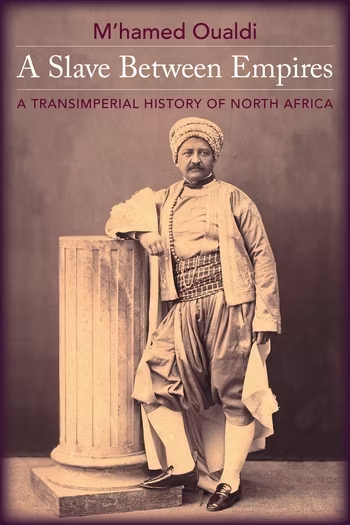
The book begins with a body, alive, but registering a deep visceral shock. A blow that is a cultural, political blow, but is experienced at the corporeal level. It is the story, and the body, of the former Tunisian dignitary Husayn Ibn ‘Abdallah who, like so many others experienced ‘the physical and mental traumas of colonization’ through what historians of North Africa have come to refer to as ‘colonial shock.’ In A Slave Between Empires: A Transimperial History of North Africa, M’hamed Oualdi begins by situating the story of Husayn with respect to this common narrative told with respect to the region sometimes called the Maghreb in Arabic. In Oualdi’s view the focus on the colonial impact, as important and severe as it was, has led to a blind spot in understanding just how a man like Husayn Ibn ‘Abdallah would have navigated, understood, and been affected by the emerging colonial reality. “(W)hich aspects of colonialism and its terrible effects might a man such as Husayn Ibn ‘Abdallah embody?” asks Oualdi.
In the pages that follow, Oualdi ably guides the reader through a study of the life of Husayn Ibn ‘Abdullah as a way of bracketing or bypassing the usual colonial and postcolonial narratives, and allowing a quite different story to emerge. A Slave Between Empires is the story of a man who begins his life as an Ottoman slave and ends it as a former Tunisian dignitary, residing in Florence, Italy. It is also much more than that. At the heart of the Oualdi’s work stands an important question on how it is even possible to study a colonized society in a way which does not simply privilege the accounts and concerns of the colonizers. The typical history of colonial North Africa, he writes, has understood its history primarily as a continuation of the stories of European nations, and as a result has privileged the sources and texts written in European languages. As a result not only the language of Arabic, but also of primary sources written in Ottoman Turkish, Berber, and Judeo-Arabic have typically been neglected.
Oualdi acknowledges the important and crucial work of historians and other scholars, beginning in the 1960s with the work of Aballah Laroui and Mohammed Chérif, in challenging the colonialist discourse and agenda, and in drawing attention to the violence and oppression inherent in colonialist discourse. Following Julia Clancy-Smith, however, Oualdi notes that ‘the construction of a temporal binary of before and after” has led to forgetting or ignoring those protagonists who do not fit the simply binary of colonizer and colonized. In focussing specifically on Husayn, his relationships, and his legacy, Oualdi hopes to ‘reconstitute social worlds and networks that tend to be hidden from view when colonization is the sole focus… and set out new lines of historical interpretation.” (13)
In my view, admittedly that of an amateur and generalist, Oualdi has succeeded in his aspirations, and has laid significant groundwork for further historical work on the Maghreb and in the area of postcolonial history and historiography more generally. Oualdi explores not only Husayn’s life, in the first part of the book, but also devotes the second part to an examination of the disputes and claims that took place surrounding his estate after his death. The purpose, throughout is not so much to construct the biography of a North African man facing European conquest and the emergence of the nation-states, as it is to challenge the very questions and assumptions that make such a reading possible. Through the lens of Husayn’s life a series of actors and agents who are typically obscured from view begin to emerge.
One of the most powerful instances of this occurs in the context of a discussion on the abolition of slavery. The abolition of slavery did not, as Oualdi demonstrates, ‘depend solely on European intervention in the Muslim world.” Instead it involved local actors like Husayn, whose own history as a ‘mamluk’ or male Caucasian slave in the Ottoman Empire coupled with a redefined identity played a profound role in how the case for abolition was made. Husayn himself would argue against slavery on primarily economic grounds, stating that universal liberty promotes industriousness and strength of character. Through his experience as a slave and then a civil servant, Oualdi contends, Husayn ‘personally experienced a profound, internal reconceptualization of the meaning and practice of slavery and state service during the reform era.” (26)
Husayn Ibn ‘Abdallah is a well chosen candidate for the historical work Oualdi hopes to achieve. Husayn’s own written works, in the forms of letters and other documents, prove a rich fountain of material from which to draw a portrait, not only of a man, but of the changing world in he lived. These changes are felt at a physical level, not only at the end of Husayn’s life as an exile in Tunis, but also in the beginning of his life as an Ottoman slave, torn from his home at a young age. Still, the story Oualdi presents is not that of a passive victim of history, but rather of someone who “like any other human being, carried his various historical experiences with him throughout his life.” These experiences shape Husayn, but he in turn plays an active role in reforming Ottoman Tunisia. The work Oualdi does in the first chapter is, essentially, the work of tracing Husayn’s actions in an effort to understand the choices he made and the conditions governing those choices. Husayn’s life, and legacy, he argues, makes sense only when seen in a contexts that ‘transcends the dichotomy of the colonial and ‘precolonial’ eras” and actually attends to the choices that Husayn makes as he navigates overlapping imperial pressures and realities.
It is not simply the individual man who becomes a figure of interest, but the network of people who surround him, most especially the daughters of two European women who were part of Husayn’s household. The story of Emma/Amina and Maria/Myriam and their mothers is central to Oualdi’s presentation of a man who navigated the overlapping cultures which he inhabited with a great deal of dexterity and ingenuity. Through adoption Husayn establishes an atypical lineage, which blended elements of Ottoman political and religious culture with the encroaching pressures of colonial occupation and the experience of exile. As Oualdi states, “there remains much to discover about how Muslim families (or those from the Muslim word) adapted to exile and how they passed on assets despite the constraints of exile and colonial domination.” (46)
The second portion of the book is devoted to unfolding the court drama in which Husayn himself was involved with respect to former Ottoman dignitaries, as well as the battles that were fought over his own estate and legacy. A number of different voices come into the foreground here, including the mothers of Husayn’s adopted daughters and Elmilik, an Algerian Jewish creditor with French nationality. Central to Oualdi’s story is ‘the idea that throughout the conflict over Husayn’s legacy, states and empires were not the main actors.” This contention allows him to explore the different types of agency which people actively employed, without reducing them to ciphers for state or empire. As he states at the end, his book brings ‘other chronologies’ into view. Rather than reading the conquest of Algeria or the invasion of Tunisia in 1881 as the only significant events in the region he develops a complex political reality, attending to the Ottoman political reforms and tracing their effect through the agency of actors like Husayn.
Oualdi’s work in guiding the reader through the entangled and overlapping web of Ottoman, North African, French, Italian, and Tunisian histories is admirable. He opens the reader up, not only to the complex history of the Maghreb, but also identifies helpful ways to overcome some of the blind spots of the colonial and postcolonial approaches to history more generally.
 The Mourning Cloak
What do you think? Leave a comment below..