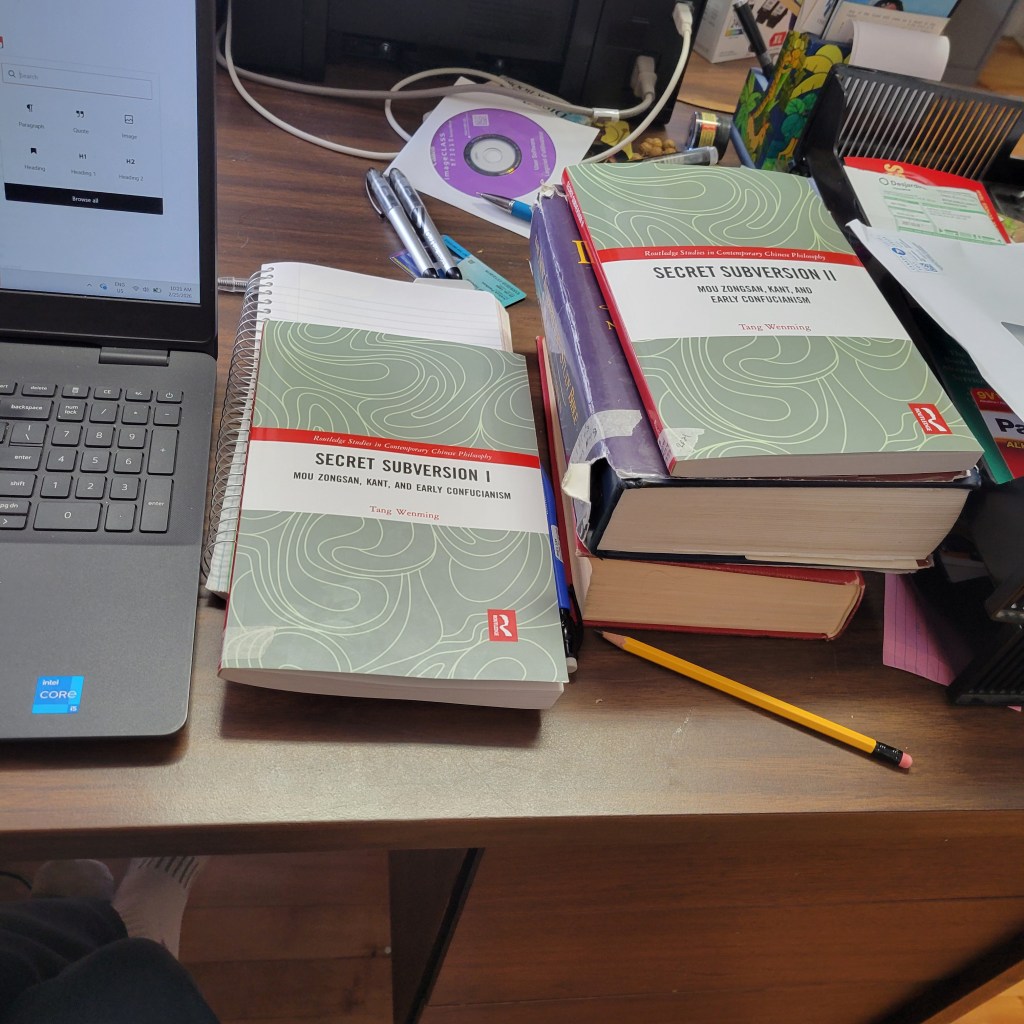
Works Reviewed. Tang Wenming Secret Subversion I: Mou Zongsan, Kant, and Early Confucianism. Routledge Studies in Contemporary Philosophy. Routledge, 2022.
Mou Zongsan (牟宗三 12 June 1909 – 12 April 1995) was a Chinese philosopher and translator who sought both to synthesize Kantian philosophy with the Neo-Daoist, Confucian, and Buddhist traditions of China, but also to demonstrate the limits of Kantian morality and indicate the ways in which Chinese thought might surpass those limits.1 Tang Wenming ( 唐文明 B. 1970- ) is a professor at Tsinghua University in the Department of Philosophy. His book Secret Subversion: Mou Zongsan, Kant, and Early Confucianism is a two volume critical analysis of Mou’s thought, in which Tang takes the earlier thinker to task for simplifying the Confucian ethos in order to make them fit into modern ethics. Tang argues that Immanuel Kant’s concept of moral autonomy distorts Confucian thought and subverts the ethical structures of the classical period.
Mou, for Tang, is emblematic of the entire Neo-Confucian movement and, more generally, of all modern approaches to Confucian thought in identifiying morality as a central element of Confucianism. The problem, for Tang, is that morality is viewed as “nothing but rational autonomy, especially compared with obedience-oriented religious belief.” (Secret Subversion I, 3) This sharp cleavage between morality and religion is derived from Kantian philosophy, and Tang is not persuaded that it is applicable to Confucian thought. Drawing on the work of Friedrich Nietzsche he argues that modern moralism masks a secretly subversive nihilism.
Tang’s use of Nietzsche appears more as an appeal to authority than a genuine philosophical argument. It is clear from the outset that he believes that Nietzsche is correct and Kant is wrong, but it is not evident why his reader should do the same. The fact that Nietzsche, or Tang, assert that “moralism is a sign of decadent life” or that “insane striving for morality is merely used to conceal the poverty of life” does not prove that this is in fact true. It may be that Nietzsche held this viewpoint, or that Tang has this opinion, but they still must convince me, the reader, why I should share it.
Tang’s use of Nietzsche also exemplifies a more general weakness in this work. Throughout my reading I had the impression that Tang assumed his reader would share his worldview, and so certain positions or perspectives were simply assumed. For example: “Besides, in Mou Zongsan’s system of though focused on ‘moral metaphysics,” Kant’s autonomy has great importance and we are also very familiar with Mou’s view.” (Secret Subversion I, 5). This sentence tells me that Tang is familiar with Mou’s system of thought, but it does not show me how Kant’s view of moral autonomy shapes Mou’s thought. It assumes that I am also familiar with Mou’s thought, and, moreover, it tacitly assumes that I share Tang’s interpretation of Mou’s work. Curiously, in a work purporting to be about Mou Zongsan and Kant, in the opening chapter there are quotes from Friedrich Nietzsche and Liang Shuming, but none from either Immanuel Kant or Mou Zongsan.
As the argument unfolds, it does become more clear. Essentially, Tang Wenming is making the case that Confucian ethics is better understood as a species of virtue ethics, rather than a form of deontological ethics. Mou Zongsan’s central mistake, for Tang, lies in identifying abstract moral autonomy as the central feature of Confucianism, whereas the cultivation and practice of virtuous relationships within a community should instead be highlighted as the main focus. Confucian benevolence, he argues, is a form of differentiated love which actively involves one’s own authenticity, an authenticity which originates “from the principle of Heaven’s mandate.” Heaven’s Mandate here refers to the idea that the human being is essentially an ethical animal.
Where I found the argument to flow most freely and naturally was in Tang’s chapters on Mencius. Although still somewhat marred by the overuse of phrases such as “As we all know,” “clearly’” and “undoubtedly” a more descriptive and engaging exchange begins to take place. By the time he gets to chapter 6 -“Mencius on the internality of benevolence and righteousness” those sorts of phrases, which tacitly assume the agreement and understanding of the reader, have largely dropped out in favour of conceptual description. In parsing the nuances of traditional Confucian thought, Tang is in his element. The exchanges between Mencius and Gongduzi are quite delightful to read, and they culminate in a strong buttressing of Tang’s contention that self-affirmation and virtuous practice can, and even should, be understood to be in harmony with one another. “From the standpoint of Confucianism, when human beings affirm themselves, accepting favor within the religious perspective, then the goodness of human nature is not harmed and human dignity is not insulted.” (Secret Subversion I, 61)
One of the areas in which Tang does seem to be in agreement with Mou is in his effort to show that Confucian ethics is superior to Western ethics, or at least that Confucian thought addresses some serious lacunae in Western thought. For Mou this meant demonstrating the idea of moral autonomy in Confucian thought as prior to its discovery in the West, whereas for Tang it means arguing that the concept of virtue is more clearly inherent in Confucian thought than in Judeo-Christian thought and its Western descendants. Attributing the ideological origin of Kantian moralism to the “Divine Command Theory” of Judeo-Christian thought, Tang maintains that the Confucian idea of “Heaven’s Mandate” does not fall into the same trap because the surrounding thought distinguishes more clearly between obligation and virtue, and is centred around an idea of virtuous responsibility rather than legal obligation.
Legalism, or divine command theory, are possible interpretations of the Judeo-Christian legacy, although Tang is arguably doing the same thing here with the Hebrew Bible and the New Testament that he accuses Mou of doing with Confucius and Mencius; that is, reading a Kantian interpretation back into texts which are doing very different things and have very different sets of concerns. The Hebrew torah can be translated teaching just as well as law, and both Judaism and Christianity include prominent voices of virtue ethics.
It is, perhaps, unsurprising given Tang’s reliance on Nietzsche that Christianity would catch a stray or two, and, to reiterate, I found Tang’s use of Nietzsche as a voice of authority to be one of the weakest parts of his argument. One particularly revealing sentence in this regard: “Nietzsche revealed that in the spiritual world of Christianity, the relationship between man and God is a relationship between debtor and creditor” (Secret Subversion I, 53) This is Nietzsche’s interpretation of Christianity, but to say that he “revealed” this suggests and oracular and dogmatic finality that does not seem appropriate. The breadth of Christian theological anthropology is not exhausted by what Nietzsche had to say on the matter, and I think that Tang would be better served by a more sustained engagement with someone like St. Thomas Aquinas or St. Augustine.
Overall, an interesting read, and an important contribution to the field of comparative philosophy and Confucian studies. It would benefit from some editing; at times the syntax left me perplexed as to the author’s intention.
 The Mourning Cloak
What do you think? Leave a comment below..