Works Reviewed. Garry Dorrien In a Post-Hegelian Spirit: Philosophical Theology as Idealistic Discontent. Waco, Texas: Baylor University Press, 2020.
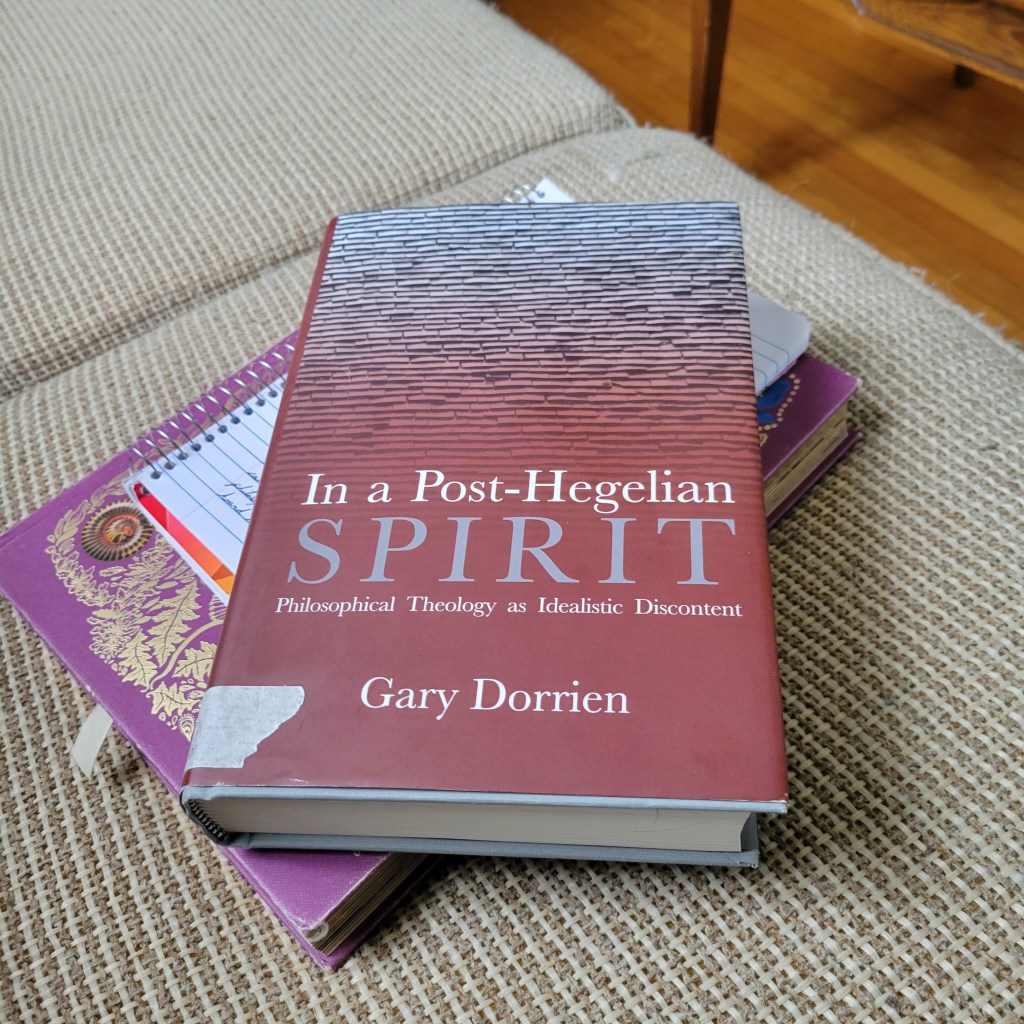
Theology, particularly in its contemporary iterations, is always involved in the process of salvage work, in the sense that it must both recuperate and reinvent a way forward out of the fraught legacy of its history. I have often wondered whether theological production has something to learn from the aesthetics of what Evan Calder Williams calls “salvagepunk.” For Williams salvagepunk was a name for what he hoped could replace the fetishism and easy romanticism of steampunk, which he terms the “weak handmaiden of Obama-era capitalism.” Salvagepunk was to be both an aesthetic and a praxis. “Acts of salvagepunk strive against and away from the ruins on which they cannot help but be built
and through which they rummage.” 1 What could a book on Hegel and liberal theology be other than a kind of rummaging and repurposing? Building something livable, maybe even lovable, out of the sprawling edifice of pre-war German idealism and its theological heirs?
To be clear, salvage is not an image or metaphor that Gary Dorrien uses in In a Post-Hegelian Spirit: Philosophical Theology as Idealistic Discontent. Dorrien speaks of ‘developing,’ a post-Hegelian philosophy; “mining” Immanuel Kant and others, sifting critiques of Hegel, featuring the personal idealist tradition, appropriating the process tradition of Alfred North Whitehead. Salvaging is my characterization of the work that Dorrien does in this book, and which I think is important work. He might not be happy with my characterization of what he is doing, given his aspiration to a grand theological vision and style. Yet, perhaps a grand visionary style does not have to be opposed to the work of salvaging from the wreckage and disappointment that attend these fraught and fragile traditions of thought.
Following Walter Benjamin’s famous observation on Paul Klee’s painting Angelus Novus one might surmise that theology’s desire to build a comprehensive body of understanding and knowledge is doomed, not only with respect to knowledge of divine things, but even more with respect to the historical dimension of its project. To quote Benjamin:
“This is how one pictures the angel of history. His face is turned toward the past. Where we perceive a chain of events, he sees one single catastrophe which keeps piling wreckage and hurls it in front of his feet. The angel would like to stay, awaken the dead, and make whole what has been smashed.” 2
The seeming impossibility of the task excuses neither the angel of history, nor the theologian, even for a moment. There is an imperative of sense-making which is laid upon us; a demand to stay in the struggle and, out of that vast wreckage, to construct a livable future, even while we are fully aware of the tentative, haphazard, and incomplete nature of that work. Timidity is not an option, because the project is daunting enough as it is, without the unnecessary additional burden of not really committing to one’s convictions. In a Post-Hegelian Spirit: Philosophical Theology as Idealistic Discontent is a bold book of theological salvage and reconstruction.
“This book,” writes Dorrien,” builds a post-Hegelian religious philosophy out of my interpretation of modern philosophical theology.” 3 I love the confidence of the line, and the combination of constructive project and interpretive work, in what I have come to think of as salvaging. Whatever conclusions one comes to about Dorrien’s project, and whether one finds it compelling or not, it has been clearly stated from the outset and one can judge the book’s success on the basis of whether or not it fulfills its stated purpose of building a post-Hegelian religious philosophy.
There is something a little humourous about this, though, since in the next paragraph Dorrien admits that the genesis of this project was a request to sum up the gist of his numerous books on philosophy and theology. The 503 pages plus extensive footnotes of in a Post-Hegelian Spirit are merely the outworking of this summary argument; an attempt to build a religious philosophy that mediates between the chasm dividing theological and religious studies in their respective approaches to religion. The interrogation of the truth claims of various religious thinkers is customarily rendered as philosophical theology, say Dorrien, but he wishes to push it towards a more encompassing vision of religious philosophy, moving beyond the theological/non-theological divide. This divide characterizes two aspects of his own professional life, but also describes quite well the apparently unbridgeable gap between the two disciplinary approaches to religion.
What Dorrien hopes to recuperate is a broad type of visionary thinking typified in the works of Paul Tillich, Alfred North Whitehead, Immanuel Kant, and especially G.W.F. Hegel. Drawing on them, but also moving beyond them by honestly acknowledging and grappling with the flaws and limitations of their work, particularly with respect to their racist and misogynistic blind spots, and pushing their insights and discoveries in a liberationist direction. The religious idealism to which Dorrien aspires is a discontented idealism, a form of religious thinking capable of immanent critique.
This is why Hegel, and a particular reading of Hegel, is of such importance to Dorrien’s work. The book is not simply a book about Hegel; it is a veritable tour de force that reevaluates the entire liberal theological tradition. Dorrien is particularly indebted to the legacy of Martin Luther King Jr., and the process theology arising out of the school of though inspired by Alfred North Whitehead. For Dorrien, although he believes we have much to learn from Whiteheadian process theology, it is “Hegel’s tragic sense of history” that cuts “deeper than Whitehead, lingering at Calvary.”4
It is this ‘lingering at Calvary” which provides Hegel with any staying power that he has, and which makes him a suitable conversation partner for the other discourse tradition which Dorrien is keen on resurrecting: liberal theology. Hegelian philosophy and liberal theology are both, as Dorrien recognizes, elusive and contentious interlocutors. Hegel can be read in at least six different ways… all the way from the panlogical right-Hegelian reading to Dorrien’s preferred reading of him as a “philosopher of love who developed a radically hospitable theology.” 5Liberal theology, for Dorrien, was first and foremost the “enterprise that broke away from authority-based thinking.”6
This is not to say that either Hegel or liberal theology are above reproach. Dorrien finds the ‘bad parts of Hegel… terrible to the point of being repugnant’ and argues that liberal theology “took a mighty fall in the twentieth century for sanctifying bourgeous civilization.”7 These are thinkers and traditions of thought that are fraught with problems, but worth salvaging for the ways in which they keep us in the struggle and keep us caring.8
“Liberal theology, according to my religion professors and everyone I read, was long dead and refuted.”9 This, for Dorrien, is the entrance into the story, and it mirrors my own experience exactly. No one was reading Adolf von Harnack or Walter Rauschenbusch. Even mentions of Schleiermacher were scarce. The neo-orthodox titans, Karl Barth chief among them, still reigned supreme. Unlike Dorrien, my syllabus contained very little in the way of the ‘death-of-God’ theologians like Thomas J.J. Altizer and William Hamilton.” The general atmosphere of my own theological studies favoured Stanley Hauerwas and the Radical Orthodoxy school of John Milbank. Liberal theology, at any rate, was passé, although perhaps not quite in the same way as it was for Dorrien.
Despite being long dead and refuted, though, liberal theology, continues to exert a kind of spectral influence. Liberal theology is the ‘enterprise that broke away from authority-based’ religious thinking, and ‘reestablished the credibility of theology as an intellectual enterprise.’ In sanctioning and sanctifying bourgeois civilization, however, liberal theology took a mighty fall; its optimistic vision of cultural progress no longer believable in post World War I Europe or Depression era America. By that point liberal theology was dominated by the Ritschlian school of thought which, says Dorrien, “oscillated between minimalizing its debt to philosophy and repudiating religious philosophy.”10 The Ritschlian school’s comfortable “Christ-of-culture” optimism makes them an easy target for the wrath of Karl Barth, but Dorrien,keeping more closely to the work of Paul Tillich, is adamant that the conventional usage of identifying liberal theology with this one particular strand of it ignores both its ‘richest intellectual flowering’ before the Ritschlian school and denigrates its ongoing creative refashioning. The story of this intellectual flowering and creative refashioning is what Dorrien tells in In a Post-Hegelian Spirit.
The book is really a monumental survey course on liberal theology and German idealism in itself. As with any decent book on G.W.F. Hegel, Dorrien starts of with that ‘unavoidable thinker in modern philosophy and religious thought,” none other than Immanuel Kant himself. Preaching a doctrine of universal freedom and human dignity while at the same time offering an ‘enlightened justification of bigotry’, the Kantian legacy is marked by bitter paradoxes and hypocrisies; contradictions that are heightened with every generation of successors.11
Kantian Foundations provide the launching point for liberal theology, built upon the seemingly unshakable foundation of critical idealism and moral religion.12 Even as the ink is drying on the third Critique, a post-Kantian movement is already on the upswing, inaugurated by Friedrich Schlegel, and ushered into Christian churches by Friedrich Schleirmacher and Samuel Taylor Coleridge. Post-Kantian Feeling draws a powerful and largely sympathetic portrait of these two men, particularly of Schleiermacher, whose privileging of Christian feeling earned Schleiermacher the ire of a certain G.W.F. Hegel. Hegel was convinced that Schleiermacher trivialized the truth about Christianity, retreating too far into the subjective, ephemeral, and indiscriminate realm of feelings.13
Hegelian Intersubjectivity rehearses six lines of Hegelian interpretation. Briefly, these are: 1)the textbook Hegel of a closed panlogical system, 2) the left-Hegelian Hegel founded by David Friedrich Strauss, renewed by Alexandre Kojève and threading through Georges Bataille, Jacques Lacan, and the Frankfurt school, 3) a latter day left-Hegelian tradition that drops the Marxian assumptions and includes such disparate thinkers as Judith Butler and Charles Taylor, 4) a left-Hegelian interpretation which does not lop off his religious basis, 5) a resumption of the metaphysical reading of Hegel, and 6) a line of interpreters deriving from the deconstruction tradition and including Bruno Bosteels, Catherine Malabou, and Slavoj Žižek.
The author places himself in the fourth tradition, alongside Dieter Henrich and Rowan Williams, reading Hegel principally as a ‘philosopher of love who fused phenomenology and ontology.’14 One has to read carefully in order not to fall into the trap of reading Hegel as a panlogical thinker. As Dorrien says, “We do not know the absolute. The absolute knows itself, through us.”15 Hegel’s task is to elaborate the coming-to-be of knowledge itself, not as a fait accompli, but as the dialectical unfolding of Spirit in human consciousness.
Hegel does, of course, use potentially off-putting phrases like “absolute knowing,” but, for the reading that Dorrien is interested in this ‘absolute knowing’ is the ‘eros of philosophy, not the static imputation of divine omniscience into human wisdom.”16 There is a cruciform aspect to this knowledge for, as Hegel writes in the Phenomenology, “Spirit wins its truth only when in utter dismemberment it finds itself.”17 Dorrien points out the link with a Lutheran theology of the cross in which death and love are linked, divine anguish inseparable from divine love. “On Calvary, Hegel taught, the abstract divine being of the unhappy consciousness died, turning the cross into a symbol of hope. God is self-communicating spirit and self-sacrificing love, not a jealous monarch or being.”18 This is the core of Hegel which Dorrien hopes to salvage, finding the basis of a liberationist and holistic theology amidst the collective, spiralling, intersubjective self-thinking of Spirit to which Hegel attends.
In the fifth chapter, Against Hegelian Spirit, Dorrien introduces his readers to a plethora of philosophers and theologians who are intellectually indebted to Hegel, out of whom he chooses four: Karl Marx, Søren Kierkegaard, Emmanuel Levinas, and Karl Barth. All of them ‘score’ against “Hegelian totality and systematic closure.”19 The basic purpose of this chapter seems to be to establish Hegel’s unavoidable mark on modern thought, allowing that these thinkers did launch legitimate critiques against the Prussian master, but also that they failed to fully understand him.
Marx inherits from Hegel the dialectical process and, famously or infamously, turns it on its head, discovering a rational kernel. The scientific claims that Marx makes are overreaching, and Dorrien rightly points out that Marxism is best construed as a ‘critique of capitalism” rather than a constructive theory of a different economic and social order.20 At the end of his section on Marx’s critique of Hegel, Dorrien brings in W.E.B Du Bois to critique Marx. He adds his own critiques noting that “Marx certainly did err about the falling rate of profit, ever-worsening misery, economic determinism…” These critiques are simply assumed, not developed or established. With respect to the falling rate of profit, at least, there are dissenting voices who would claim that Marx did not err on that point. Most notably this is seen in the work of the “Temporal Single-System Interpretation” of thinkers like Andrew Kliman and Alan Freeman.21
Dorrien’s general point still stands, namely that Marx, like Kierkegaard, “corrected Hegel by “expounding the distinct situation of particular knowing subjects.”22 Kierkegaard, with his various pseudonyms, takes his critique of Hegel in a deeply personal, existential direction. The power of existentialist writing and rhetoric resounds powerfully with the crisis theologies of Paul Tillich and Karl Barth.
Dorrien takes careful aim at Barth, as well as at Emmanuel Levinas. Barth reasoned that because Hegel’s God revealed out of “logical necessity” it could not really be the Christian God who loves in freedom.23 Dorrien contends that this takes for granted the closed-system interpretation of Hegel, relegating negation and tragedy to ‘subordinate elements of a system.” Dorrien does quite a good job of rendering Barth’s position, and in the end I am not entirely convinced that his critique of Barth quite lands.
From Barth and Levinas we shift gears to Personal Idealism, tracing the legacy of personal idealist philosophies in Germany and the United States. This chapter was quite a theological education for me, particularly about the personalist school of theology in the United States, associated with names like Borden Parker Bowne. The critique of Karl Barth enters into sharper relief in this chapter, not in a direct way, but through references to the ‘flood of irrationalism’ unleashed by thinkers like Barth, Nietzsche and Kierkegaard. The chapter concludes with a presentation of the work of Walter Muelder for whom the neo-orthodox regnancy in theology, along with many of the racist biases still present in liberal theology were hindering the witness of the church in America.
“The only vital school of liberal theology in North America is the one founded on the organic philosophy of Alfred North Whitehead.”24 Whitehead provides a philosophical foundation for the Chicago school of theology, giving rise to “process theology.”
As in the preceding chapters Dorrien brilliantly draws out key figures in the story that he is constructing, providing a vignette not only into the ideas themselves but the way in they shaped the thinkers and institutions who espoused them. Never far out of view is the social, personal, and interpersonal struggles that attend each of these thinkers. The old debate between Schleiermacher’s emphasis on feeling and Hegel’s on the intellect continually resurfaces in new forms. Here we meet Charles Hartshorne, Daniel Day Williams, Bernard E. Meland, John B. Cobb and others. Within this Whiteheadian Ordering, Meland, in particular, recovers from neo-orthodoxy the importance of myth, but insists that liberal theology was right to disavow authority religion. 25
Paul Tillich brings us deeper into the existential abyss in Neo-Hegelian Theonomy. Dorrien acknowledges Tillich as the philosophical theologian who has influenced him more than any other. Tillich moves towards religious socialism, critiques Barth’s otherworldliness, but fails, in Dorrien’s view because he opts out of ‘solidarity movements for social justice and postcolonial liberation.”
The stage is now set for what is essentially the heart of the book. G.W.F. Hegel might provide the intellectual scaffolding for Dorrien’s project, but the emotional depth springs from Martin Luther King Jr. Struggling for Liberation introduces the reader, in a fashion I have grown accustomed to at this point, not merely to King, but to W.E.B. Du Bois and Rosemary Radford Ruether. This way of organizing the chapters, presenting a few key thinkers at once, allows Dorrien to elaborate a certain philosophical movement, in this case a liberationist philosophy, in a dynamic way, outlining some of the differences in temperament and experience of its key thinkers.
Dorrien connects each of these thinkers to Hegel, either directly or indirectly through personality theory, and begins to move through a history of liberationist critique. “Liberationist critique begins with harm and critique, yielding a fierce desire to understand, as exemplified by Du Bois, King, and Ruether.”26
The inclusion of Du Bois allows Dorrien to flesh out the long history of the black social gospel tradition, following Du Bois’ fraught experience with the Christian legacy. And then we come to King.
King understood, writes Dorrien, that he “was the most hated person in America” because he compelled “white Americans to confront the hostility for black Americans that they variously displayed and covered up.”27 King’s gift, though, was in inspiring and uniting coalitions of people that had not existed before. “He inspired and united through the power of Christian love, his preaching artistry, and his almost superhuman magnanimity.”28
Dorrien traces King’s story from his early childhood and through his university years. He takes time to debunk certain received ideas about King and his intellectual biography, rooted in popular biographies of the man, and sometimes taking King’s own pronouncements. Dorrien argues that King’s graduate studies in theology were much more important to King than they were later made out to be, whereas the Gandhian influence has been seriously exaggerated. He then goes on to demonstrate just exactly how some of King’s teachers, theologians whom we were introduced to earlier in the book, impacted King. It is through his education that King is introduced to Hegel. “Above all, King loved the same thing in Hegel that caught Du Bois – the notion that Spirit uses the passions of partly unsuspecting individuals to fulfill its aims of self-consciousness and freedom.”29
Rounding off the trifecta we are introduced to Rosemary Radford Ruether and feminist theology. Through her lens the other blind spot of liberal theology becomes visible. If the first was racism, the second is sexism. Dorrien details her career through the early beginnings of feminist theology in the 1970s when Ruether and others were largely sidelined by the male establishment, all the way to the point when future generations of feminists pillory Ruether as hopelessly antiquated and part of the problem. Dorrien presents a Ruether who is much more nuanced, savvy, and worthy of a ‘more accurate remembering.” Once again, salvagework. In particular he draws attention to the way in which each of Ruether’s books had a “community behind it,” and how she exemplified the maxim “everything is related.” 30
We are moving now towards the end. Two chapters remain. Rethinking Relationity, and In a Post-Hegelian Spirit, the title track. Rethinking Relationality begins with an admission of the fragmentation of theology in our fragmented times. The keyword for this chapter is entanglement, explored through the works of David Tracy, Peter Hodgson, Edward Farley, and Catherine Keller. The upshot of this chapter, as far as I understand it, is that Whiteheadian process theology of all its many varieties is at an impasse, or is unified in, giving ‘up the onto-theological God whose Being is the One.” This moves us back to Hegel, who conceived the Trinity as “a dynamic and intersubjective way to save the neo-Platonic One.”31
Hegel, in Dorrien’s account, is the thinker who provides an idealistic theology imbued with a sense of tragedy, real-world oppression, and exclusion and, if pushed, even with a sense of the danger of its own prideful intellectualism. It is not that Hegel got everything right, but that Hegel ‘turned his post-Kantian ontology of love into a theology of intersubjective Spirit fitting his discovery of social subjectivity.” That is, that there is a framework of a sort for love in action, which does not simply eschew the difficult philosophical questions, but instead stays with them.
The ending of Dorrien’s book is quite beautiful; a passionate an thoughtful call to care, to be angry, to stay in the struggle. And so, in my estimation, Dorrien has, if not built a comprehensive post-Hegelian philosophical framework, at least begun a good work and offered valuable tools and a direction for such a project, necessarily an ongoing project, to continue.
- Evan Calder Williams Uneven and Combined Apocalypse (Winchester, UK: Zero Books, 2011), 20. ↩︎
- Walter Benjamin, On the Concept of History. (Available online at https://www.sfu.ca/~andrewf/CONCEPT2.html. Accessed on June 27, 2024.) ↩︎
- Gary Dorrien, In a Post-Hegelian Spirit: Philosophical Theology as Idealistic Discontent. (Baylor University Press, 2020), ix. ↩︎
- Ibid. 1. ↩︎
- Ibid., In a Post-Hegelian Spirit, 2. ↩︎
- Ibid., In a Post-Hegelian Spirit, 3. ↩︎
- Ibid. ↩︎
- Ibid., 503. ↩︎
- Ibid., xi ↩︎
- Ibid., 13. ↩︎
- Ibid., 67. ↩︎
- Ibid., 165. ↩︎
- Ibid., 178 ↩︎
- See, for example, Andrew Kliman, Reclaiming Marx’s “Capital”: A Refutation of the Myth of Inconsistency, Lanham, MD: Lexington Books, 2007, ↩︎
- Post-Hegelian Spirit, 178.
↩︎ - Ibid., 198. ↩︎
- Ibid., 267. ↩︎
- Ibid., 300. ↩︎
- Ibid., 340. ↩︎
- Ibid., 355 ↩︎
- Ibid. ↩︎
- Ibid., 361. ↩︎
- Ibid., 386, ↩︎
- Ibid. 442. ↩︎
 The Mourning Cloak
What do you think? Leave a comment below..