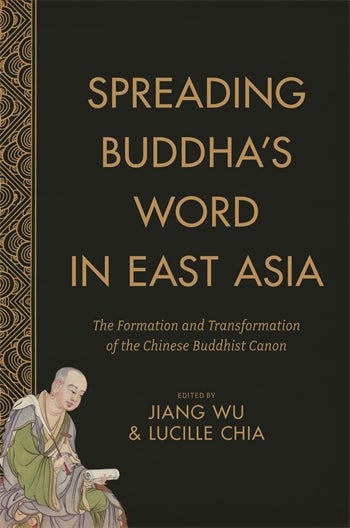
History of the book and history of religion are two of my areas of interest, and Spreading Buddha’s Word in East Asia: The Formation and Transformation of the Chinese Buddhist Canon is an impressive work of scholarship which bridges those fields to bring to life the story of the compilation of one of the world’s largest collections of religious texts: the Sinitic Buddhist canons. It is a story that spans centuries, dynasties, and various Buddhist sects, and incorporates not only monks, emperors, and scholars, but also the devotion of lay practitioners, legends, community organization, fundraising, and technological innovation.
Jiang Wu and Lucille Chia have brought together a number of scholars working on this massive collection of writings, to grant insight not only into their origins, but into the various social, political, economic, technological, and religious climates and upheavals which have shaped and reshaped the Buddhist Canon in China and its surrounding countries over the course of millennia. As the title suggests, the Buddhist canon is treated in this account not merely as a static collection of texts, but as the focus on intense devotional activity, whose ‘creation, production, distribution, and maintenance,’ required considerable effort.
Lewis Lancaster, in his preface to this book, describes it as something of a ‘daring gesture,’ to even approach the topic of the “Chinese Buddhist canon,’ given the scholarly climate of the times in which it was first approached, in which a ‘postmodern hermeneutics of suspicion’ had cast the very notion of a ‘canon’ in disrepute as a hopelessly elitist one. Jiang Wu picks up on this criticism in more detail, suggesting that the very word canon has become unpopular in contemporary academia because it reminds us too much of “colonialism and ‘Orientalism,’ of the ways Western scholars ‘canonized the knowledge of the East.’” The result, he argues, ‘ is that scholars tend to stay away from the “canon but focus on “practice,” which is by itself an abstract construction.” This particular sentence struck me quite forcefully, as it seems consonant with my own, admittedly very limited and anecdotal, exposure to contemporary apperceptions of Buddhism. Conversations that I have had with people interested in or ‘practicing’ Buddhism, tend to certain around the concept of ‘practice’ which, in turn, is typically defined in very vague terms of mindfulness or meditation. This notion of ‘practice’, unconstrained by any body of textual unity, also leads towards an account of East Asian Buddhism centered around the formation of different sectarian movements. Jiang Wu contends that an emphasis on the Chinese Buddhist Canon – which remained ‘a remarkably nonsectarian textual repertoire of the heritage of Chinese Buddhism.” (40)
Confronting the challenges posed by criticisms of the very notion of a ‘canon’ as elitist has led Jiang Wu and the other contributors to this volume to approach the canon not simply as a textual repository, but in terms of the ‘politics, social more, philosophical discourses, material science, and religious values,’ which surround and inform the shaping and reshaping of the canon over the course of three thousand years. Lancaster describes the shift in perspective as one of viewing the canon as an ‘event’ rather than an object. Central to this event, in my own view, is Jiang Wu’s contention that the canon was itself an object of worship, and therefore gives insight into devotional practice. Devotional practice, in this context, is to be understood in the context of its social and political dimensions:
“In Buddhist communities, a complete set of the canon has also been treated as the object of worship and devotion, acquiring significant textual and spiritual authority. Because of the complexity of its structure and historical evolution, the formation and transformation of the Chinese Buddhist canon can be considered a phenomenon with religious, social, and textual significance in Buddhist history.”
Jiang Wu Spreading Buddha’s Word in East Asia, 15.
Spreading Buddha’s Word in East Asia is the outcome of a conference, where the material was first presented, and reflects the struggle of scholars attempting to make sense of a truly enormous body of texts. Quite aside from the religious texts themselves, there are lists, catalogues, commentaries, and translations – all of which point toward the production of the canon involved the whole of society. This holistic approach to the study of canon, as stated above, is a central part of what the book is trying to achieve – setting the ground for further work on how the Chinese Buddhist canon illuminates the history not only of China, but of East Asian Buddhism more generally. Treatment of source material, therefore, diligent and thorough.
This, at least, is my observation as an outsider to the field. The book is divided into three categories, beginning with an overview of the essential categories and critical issues encountered in the study of a textual tradition, particularly the textual tradition of Chinese Buddhism. Here the reader is first introduced to the rather remarkable fact that, although the idea of a canon of religious texts was brought over from India at the beginning of the work of Buddhist translation, there is very “little evidence showing that the Chinese modeled their canon on the basis of an existing ‘Ur-Canon” of non-Chinese origin. Essentially, though, the idea of the canon functions as a sort of regulative principle accounting, at least in part, for the tendency of the canon to include more and more texts in the hope of arriving at a complete canon. Indeed, the myths and legends around the canon inspired Chinese Buddhists to embark on journeys to India.
The “Cult of the Book,” present in Mahayana teaching found a ready partner in the Chinese literary tradition, writes Jiang Wu, which promoted the development of a “Cult of the Canon,” flourishing alongside the transition from oral to written traditions. Jiang Wu’s focus on aspects of devotional practice provides a lens through which to consider various types of activities involved in the production of the canon, including patronage, consecration and worship of texts the cult of the revolving repository, rituals of reading and writings and more. (47) The cult of the revolving repository was one that I found particularly fascinating, it gives a very visual sense to the Buddhist notion of “turning the wheel of the Dharma.” The sheer number of texts that eventually come to be included in the Buddhist canon is astounding, as is the realization that these texts were physical objects – whether written in stone or on scrolls or later printed, which had to be produced and maintained. These acts of maintenance and production required serious attention to various details, for example feeding the people who carved the printing blocks or cataloguing the scriptures and commentaries, and all of these activities were centered around devotion to the written words of the Buddha and the desire to attain religious merit through preserving and disseminating those words.
The second part of the book details “The Formative Period” of the Buddhist canon. We begin with Stefano Zaccheti’s essay on “Notions and Visions of the Canon in Early Chinese Buddhism,” in which he makes the case that the Chinese Buddhist canon, in comparison with other Buddhist collections of scripture, is notable for its inclusive nature and its conservative nature. Here inclusive refers to the tendency to include and integrate scriptures from a variety of Buddhist traditions. Conservative, far from referring to any political ideology, simply means that the Chinese Buddhist canon is “historically inclusive” in the way it preserves multiple translations of the same scripture. The attention given to translators, from the very beginning of the story of the Chinese Buddhist canon is quite remarkable to me. In the West the figure of the translator has typically been an unsung and often unnamed hero, at least until recently, whereas in the establishment of the Chinese Buddhist canon the translators were often an important consideration in assessing the authenticity of the text.
Zaccheti continues with an analysis of how early visions of the canon, particularly that of Daoan, led to “complex patterns of interaction and adaption.” (97) On occasion an entirely novel category of scripture, or distinctive usage of an existing category might even emerge.
Tanya Storch’s essay on “Fei Changfang’s Record of the Three Treasures Throughout the Successive Dynasties,” brings us deeper yet into the minutae of cataloging details, and the political, philosophical, and theological implications of those details. What I greatly appreciated about Storch’s essay was her comparative work, which offered me some points of reference with the Christian tradition which is the religious traditions with which I am most familiar. Fei Changfang’s efforts at reshaping Chinese historiography to appear more Buddhist thus become comparable to the Origen of Alexandria’s use of the “allegorical method” to harmonize the messages of the Old and New Testament. Fei Changfang, who is largely reviled dismissed and yet unmistakably important to the tradition that follows is perhaps akin to Origen in other ways as well. Fei Changfang is significant for his development and contribution to the history of Buddhist bibliography, and for his use of dividing the canon according to imperial dynasties. His work weaves the canon more closely together with Chinese history, thereby assigning a far greater respect to Chinese original texts than had previously been possible.
Part III introduces us to the “Advent of Printing” detailing the birth of the first printed canon, Kaibao Canon, and its impacts. This is in itself the story of a quite impressive undertaking, begun by the newly established Song Dynasty, and one in which the production of the canon takes on distinctive political role reflecting a new state attitude toward Buddhism, and becoming in turn a valuable diplomatic tool. This story sets the stage for further reflection on the expansion and adaption of the Buddhist canon in the surrounding countries of East Asia, to which we return in the part IV.
Before continuing that story, however, Lucille Chia introduces us the “Life and Afterlife of Qisha Canon. This is quite a different enterprise, as Qisha canon was the private undertaking of a monastery, rather than a state-sponsored enterprise, and so reflected very different concerns and motivations. The exact composition of the text is quite distinct, including a number of esoteric sutras from the Tibetan tradition appear in the Qisha Canon due to the involvement of Guan Zhuba who had extensive experience in compiling other Buddhist collections in the Tangut, Tibetan, Chienes, and possibly Uighur languages.
Finally, in “Managing the Dharma Treasure: Darui Long goes through some of the practical issues of handling and maintaining a canon with reference to the Yongle Southern Canon, Jiaxing Canon, and Qing Canon. Here, for example, we get into accounts of how the Ministry of Rites enacted legislation to avoid the problems of printing houses using inferior material and overcharging. As I have, on occasion, had newly purchased books come to pieces due to poor binding practices, I could not help but appreciate the important work that the ministry of rites was doing for 13th century Chinese readers.
Part IV: The Canon Beyond China takes us into the creation of the Goryeo Canon in what is now Korea, and into the modern period with the Taisho Canon in Japan. The story of the Goryeo Canon further deepens the connections between the state and religion/spirituality, in which the canon comes to be used as a talisman for warding off disasters and invasions. Here, once again, the focus on devotional practices allows a focus on the distinctive ways in which the Canon is employed. “(I)n Korea, the canon was incorporated into an indigenous belief system, and thus functioned as part of “Buddhism of praying for blessing and exorcising calamaties.”
Finally, Taisho Canon tells the story of a Buddhism in Japan that, following the changes brought about by the Meiji restoration, has to meet new challenges and persecutions. It is the story of modernization, and of Buddhist priests studying abroad, particularly under the tutelage of Max Muller in Germany. As much as the creation of the Taisho canon was motivated by academic concerns and, to some extent, Japanese nationalism, Greg Wilkinson, the author of the essay, also emphasizes the role that religious devotion and a missionary impulse played in the creation of this work. “Less known is how the production of the modern Japanese edition was influenced by a combination of religious devotion, Western-style academic scholarship, and Japan’s rising nationalism. In religious terms, Buddhist priests and intellectuals in Japan believed that these new printings of the Chinese Tripitaka would not only elevate Buddhism and Japan but also aid Buddhist evangelism throughout the world.”
The emphasis on the theme of devotion, coupled with serious attention to the political, social, economic, and material dimensions of the history of the Buddhist Canon in China and beyond make for a compelling history of the religious landscape in that part of the world. It is certainly a demanding history, but the authors provide a clear and helpful overview for anyone interested in studying Chinese Buddhism, or, indeed, the history of religion and of writing more generally.
 The Mourning Cloak
What do you think? Leave a comment below..